The Science of Ecommerce CRO | Strategic Insights for Performance-Driven Teams
Get some tips and tricks behind the science of eCommerce Conversion Optimization to boost your online revenue.
TL;DR: Most eCommerce stores treat conversion optimization as a design problem. It is a behavioral science problem. The brands that win apply cognitive psychology, structured experimentation, and voice-of-customer data to every touchpoint. That is what ConversionFlow does, and why our clients average a 10.2% CVR lift and 18.3x ROI.
Introduction
Your traffic is not your problem. Your buyers' brains are.
Every visitor who lands on your store brings a lifetime of psychological wiring with them. They scan for social proof before they read your copy. They respond to scarcity before they evaluate your price. They abandon checkout because of a fee they did not expect, not because your site is ugly. These are not opinions. They are documented, replicable patterns of human behavior.
CRO is the discipline of engineering your store around those patterns. It is not about running random A/B tests or tweaking button colors. It is applied behavioral science, grounded in data, validated through experimentation, and refined through your customers' own words.
ConversionFlow works with 230+ Shopify stores using exactly this methodology. The results are not accidental. A 10.2% average CVR lift, a 21.2% average AOV increase, and a 37.3% average profit increase all come from treating every page as a behavioral experiment. This post breaks down the science behind that approach.
1. Behavioral Science (The Engine Behind Every Purchase Decision)
Every purchase is a decision under uncertainty. Your buyer is weighing expected reward against perceived risk, doing it in seconds, and doing it mostly unconsciously.
The field of behavioral economics explains why people consistently deviate from "rational" buying decisions. Loss aversion, social proof, anchoring, and the mere exposure effect are not abstract concepts. They are forces operating on your product pages right now.
The BJ Fogg Behavior Model frames this clearly: behavior happens when motivation, ability, and a prompt converge at the same moment. If your store creates friction at any of those three points, the conversion collapses. Your job is to reduce friction, amplify motivation, and time your prompts correctly.
Figgy, a ConversionFlow client, saw a 33% CVR boost from a single headline change. The product name was replaced with language that matched how their customers actually described the product. No redesign. No new traffic. Just behavioral science applied to copy.
2. The Customer Journey (A Data Model, Not a Metaphor)
The customer journey is not a marketing concept. It is a data model with measurable drop-off points at every stage.
Awareness, consideration, decision, and post-purchase are not phases to describe in a deck. They are conversion funnels with specific friction signatures. Awareness-stage visitors bounce because your messaging does not match what they searched for. Consideration-stage visitors leave because your product page does not answer the objection forming in their head. Decision-stage visitors abandon checkout because an unexpected cost appeared.
Map your journey with data. Look at where traffic enters, which pages hold attention, and exactly where users exit. A Shopify CRO audit is the fastest way to surface those exit points with precision.
Once you know where people leave, you know where to run experiments. That is a science problem, not a design problem.
3. Cognitive Biases (The Shortcuts Your Buyers' Brains Are Already Using)
Your buyers are not reading every word on your page. They are pattern-matching. They are using mental shortcuts, known as cognitive biases, to decide whether to trust you, whether your price is fair, and whether they need the product right now.
Loss aversion is the tendency to feel losses more intensely than equivalent gains. "Do not miss out" outperforms "Get access to" because of this. Frame your offers around what buyers stand to lose by not acting.
Anchoring means the first number a buyer sees shapes how they evaluate every number after it. Show your original price before your sale price. Display your highest-tier plan first.
Social proof reduces uncertainty by borrowing trust from others. Reviews, purchase counts, and user-generated content all activate the same mechanism: if others made this decision, it was probably the right one.
The mere exposure effect means familiarity breeds preference. Retargeting works partly because of this bias. The more a buyer has seen your brand, the lower their perceived risk of buying.
4. Social Proof Mechanics (Trust Is Not Built, It Is Borrowed)
Social proof is not a feature you add to a product page. It is an architecture decision about where, how, and in what format you surface other buyers' experiences.
Reviews near the buy button outperform reviews at the bottom of the page. Specific reviews outperform generic ones. Photo and video reviews outperform text-only. These are not aesthetic choices. They are documented conversion lifts.
RTIC Outdoors generated $1M+ in annualized revenue from a single carousel test. The change was switching to outcome-driven copy that described what buyers actually do with the product. Buyers recognized themselves in the copy. Recognition is trust.
Place social proof at every point of hesitation: next to price, near the add-to-cart button, and inside the checkout flow. Hesitation has a location. Put trust there.
5. Urgency and Scarcity Science (Motivation Has a Half-Life)
Motivation degrades with time. A buyer who is 80% convinced today will be 50% convinced tomorrow. This is a documented property of human motivation.
Urgency and scarcity tactics work because they shorten the window between motivation and action. Low-stock notifications, countdown timers, and limited-time offers all serve the same function: they make "later" feel like a real cost.
But the science here requires honesty. Manufactured urgency destroys trust in the long term. Real urgency, actual limited inventory, genuine sale windows, seasonal constraints, outperforms fake urgency in every long-term test.
Dermaclara ran a seasonal CRO program with ConversionFlow built around real Black Friday urgency. The result: a 10% CVR and $700K+ in Black Friday revenue. The program worked because the scarcity was real and the messaging matched the moment.
6. Friction Analysis (Every Extra Click Has a Price)
Friction is anything that makes completing a purchase harder than it needs to be. It is the gap between buyer intent and buyer action.
Friction shows up as slow page load times, confusing navigation, unclear product descriptions, too many form fields, unexpected shipping costs, and checkout flows that demand information before they need it. Each friction point is a leak in your funnel.
Heat maps and click-tracking data make friction visible. If buyers are clicking on non-clickable elements, they expect functionality that is not there. If they are scrolling past your buy button without engaging, your value proposition has not landed yet.
Cute.Camera reduced ad spend by 50% while maintaining revenue, not by finding cheaper traffic, but by eliminating the friction that was wasting the traffic they already had.
7. Voice-of-Customer Research (The Science of Listening First)
Your buyers know why they did not convert. They will tell you, if you ask the right questions.
Voice-of-customer research is the practice of collecting, organizing, and applying direct buyer language to your store's messaging. Surveys, post-purchase interviews, review mining, and on-site polls all surface the exact words your buyers use to describe their problems and their hesitations.
When your product page uses the same language your buyers use internally, something clicks. The cognitive load of translation drops. The page feels like it was written for them, because it was.
Lifepro Fitness reached a 14% CVR and $1.35M in annualized revenue by grounding their messaging in voice-of-customer data. The science was listening first, then writing. Not the other way around.
8. Structured Experimentation (A/B Testing Is Not Optional)
Every assumption about your store is a hypothesis. A/B testing is how you find out whether your hypotheses are right.
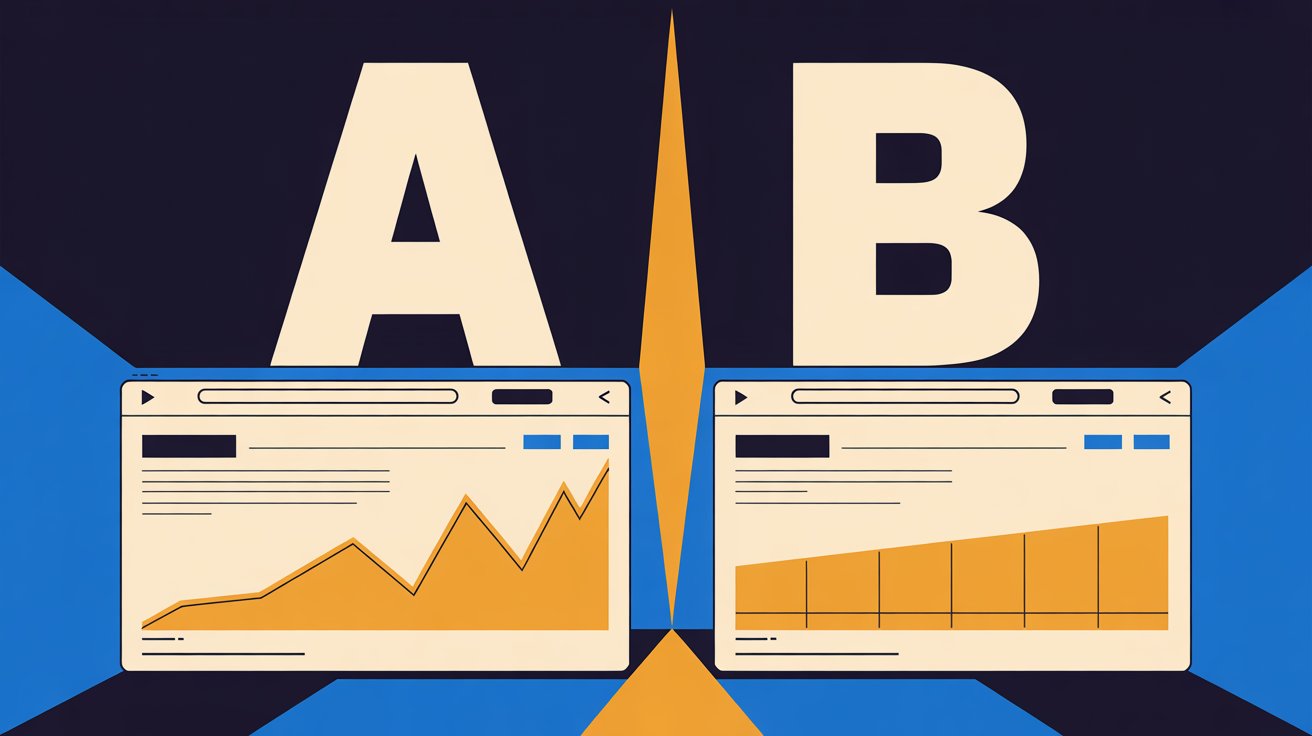
A/B testing means running two versions of a page element simultaneously, with statistically significant traffic, and measuring which version drives more of the outcome you want. Define your primary metric before you start. Conversion rate, AOV, profit per visitor, revenue per session. Choose one and test to it.
The mistake most stores make is running tests too small or too short to reach statistical significance. A test that runs for four days with 300 visitors per variant is not a test. It is a coin flip. You need enough data to know whether a result is real or noise.
ConversionFlow clients run structured testing programs with defined hypotheses, traffic requirements, and measurement frameworks. That methodology is why we see consistent lifts across 230+ stores, not random wins.
9. Pricing Psychology (Your Price Is Never Just a Number)
Price is not a number. It is a signal.
How you display your price communicates value, quality, urgency, and fairness simultaneously. The same product displayed at $150 with a strikethrough next to $99 performs better than $99 alone, because anchoring reframes the deal.
Charm pricing (ending in 9 or 7) activates left-digit anchoring, the tendency to weight the leftmost digit disproportionately. A price of $79 reads as "seventy-something" before the brain processes the full number.
Bundle pricing and tiered offers work because of decoy effects, anchoring, and loss aversion in combination. Your mid-tier option should be designed to win. The high-tier option exists partly to make the mid-tier look reasonable.
10. The Measurement Stack (Science Requires Instruments)
You cannot optimize what you cannot measure. Your measurement stack is as important as your optimization tactics.
Every ConversionFlow engagement starts with a data audit. That means verifying that Google Analytics or the equivalent is tracking correctly, that conversion events are firing, that session recordings are capturing behavior, and that heat maps are active on high-traffic pages. If the data is wrong, every decision downstream is wrong.
Beyond basic analytics, track micro-conversions: add-to-cart rate, product page engagement, checkout initiation, and checkout completion as separate steps. A high add-to-cart rate with low checkout completion points to checkout friction. A low add-to-cart rate points to product page failure.
Profit per visitor is the metric that ties everything together. CVR improvements that shrink margins are not wins. Measure revenue and profit impact together, always.
Final Thought: Guesswork Is Expensive. Science Is Not.
Every page on your store is either working with buyer psychology or against it. There is no neutral ground.
The brands that compound growth year over year are not the ones with the biggest ad budgets. They are the ones who understand why their buyers hesitate, what language moves them, and which experiments produce real lifts versus random noise. That is the science of eCommerce CRO. It is learnable, repeatable, and measurable.
ConversionFlow has applied this methodology across 230+ Shopify stores and generated results that compound. The first step is understanding your specific friction points, not borrowing generic best practices.
Book a Free Conversion Strategy Session — find out exactly where your store is losing conversions and what the data says about fixing it.
Frequently Asked Questions
Questions about the behavioral science behind CRO? Here's what we hear most.
About Author