Voice of Customer Research for Ecommerce: How to Find the Words That Make People Buy
Your customers are already telling you exactly what to write on your homepage. Voice of customer research is the process of collecting that language and putting it where it can do real work: your headlines, PDPs, emails, and ad copy.
TL;DR: Your customers are already describing your product better than your copywriter is. Voice of customer research collects that language and puts it where it can do real work: your headlines, PDPs, emails, and ad copy.
Your customers are already telling you exactly what to write on your homepage. You're just not listening.
Most ecommerce copy gets written from the inside out. A founder, a marketer, or an agency takes what they know about the product and tries to make it sound compelling. The result is polished copy built on assumptions: what they think sounds persuasive, the language they would use, the benefits they find obvious. It feels right when you write it. It quietly fails when real people land on the page.
The gap between how a brand describes its product and how a customer experiences it is where conversion rates go to die. Customers don't care about your feature set. They care about their problem, their hesitation, and whether your product actually solves it for someone like them.
Voice of customer research closes that gap. It's the process of gathering your customers' actual language and using it to write copy, design flows, and make CRO decisions grounded in reality rather than guesswork. This is not a new concept. It's a chronically underused one.
What Voice of Customer Data Actually Is (And What It Isn't)
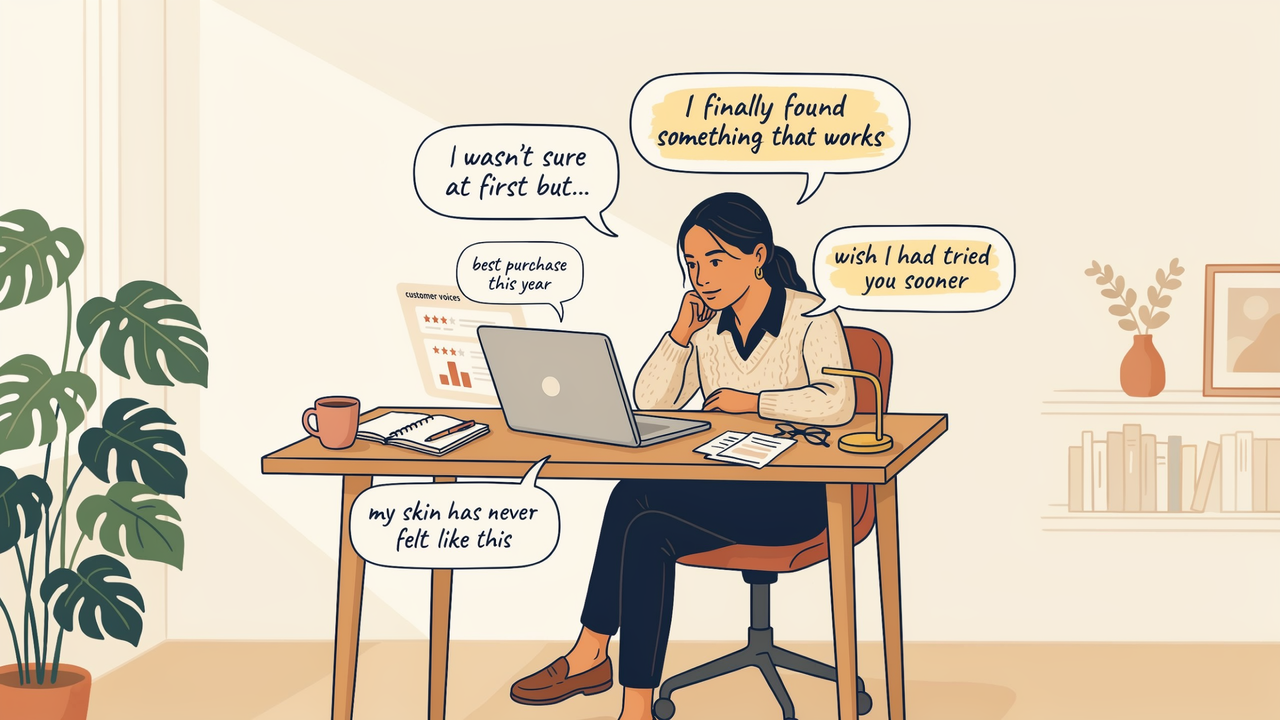
VoC data is direct, unfiltered language from real customers describing their experience: the problem they had, the hesitation they felt before buying, and the outcome they got afterward. It's the specific, sometimes awkward, often brilliant phrases people use when they're not trying to sound professional.
It is not focus group summaries. It is not brand-generated testimonials that went through three rounds of editing. It is not a paraphrased version of what your support team thinks customers mean. The raw language is what matters.
"I was finally able to get my kids off their iPads" is voice of customer. "Promotes active play" is marketing copy. One of those converts. One of those gets scrolled past.
VoC is the difference between copy that sounds good in a brand deck and copy that actually gets people to click Add to Cart. The words that close sales are almost always borrowed, not invented.
Where to Find It (7 Sources)
1. Review Mining (The Goldmine You Already Have)
Your existing reviews are a free, always-available VoC library. Start there, then expand outward: Amazon reviews for similar products in your category, Trustpilot, and Reddit threads where people discuss problems your product solves.
What you're looking for isn't stars or sentiment. You're looking for three specific language patterns. Transformation language: "I used to... now I..." This is before-and-after framing that belongs in your headline. Objection language: "I was worried about... but..." These are the objections your PDP probably isn't addressing. Surprise moments: "I didn't expect..." These are your differentiators, as told by the people who actually experienced them.
Copy these phrases directly into a working document. Don't clean them up. Don't paraphrase them. The informal grammar and specific phrasing is the point.
These phrases belong in your headlines, not buried in a spreadsheet no one opens.
2. Post-Purchase Surveys (The Two-Minute Ask That Pays for Itself)
A well-timed post-purchase survey is one of the highest-leverage CRO tools available to ecommerce brands. Tools like Fairing (formerly EnquireLabs), Typeform, and Fillout make it easy to trigger a short survey right after checkout, when customers are most engaged and most willing to tell you why they bought.
The questions that matter most: "What almost stopped you from buying?" "How would you describe this product to a friend?" "What problem were you trying to solve?"
That first question is the single most valuable CRO question you can ask. It surfaces real objections you may not know exist, surfaced by the people who overcame them. Those are the doubts your hesitating prospects still have.
ConversionFlow has seen firsthand what happens when you take this seriously. For Figgy, a children's furniture brand, post-purchase survey data revealed that customers were consistently confused by the product label "Add-Ons." They used a different phrase on their own: "Expansion Packs." One language change, sourced directly from survey responses, drove a 33% conversion boost. The copy didn't change because someone had a clever idea. It changed because the customers said so.
3. Customer Support Transcripts (What They Ask Before They Buy)
Your support inbox is not just a customer service function. It's a pre-purchase objection log. Every email asking about sizing, shipping timelines, return windows, ingredient lists, or compatibility is a question your product page didn't answer well enough.
Go through your last 90 days of support tickets and tag recurring questions by theme. Shipping. Sizing. Compatibility. Returns. Ingredients. Anything that appears more than three times is a conversion problem that your page hasn't solved yet. Tools like Gorgias and Zendesk let you tag at scale. A spreadsheet works too, if volume is low.
The fix is usually simple: add a FAQ block, update the product description, make the relevant information findable above the fold.
Your support team is sitting on some of your best copy briefs. Ask them.
4. Exit Intent Surveys (Catching Them Before They Leave)
When someone is about to leave your site without buying, asking them why is worth more than guessing. A single-question exit intent survey keeps friction low and response rates high.
Ask: "What stopped you from completing your purchase today?" Not a popup with five fields and a dropdown menu. One question. A text box. That's it.
Tools like Hotjar, Qualaroo, and Wisepops handle the trigger logic. Even 30-50 responses is enough to see patterns. Price hesitation, unexpected shipping costs, confusion about sizing, lack of trust signals. These are fixable problems. You just have to know they exist.
Thirty responses telling you the same thing is more valuable than a hundred A/B test variants running against each other.
5. On-Site Search Terms (Intent, Unfiltered)
What customers type into your search bar is exactly what they came looking for. No filter, no brand bias. Pure intent.
If customers are searching for terms you don't use in your navigation or product descriptions, that's a copy gap. They're looking for something specific that your language isn't matching. Mismatched vocabulary creates friction, and friction kills conversions.
The Figgy "Expansion Packs" discovery didn't start only with survey data. It also showed up in on-site search behavior. Customers typed one thing. The store said another. The words didn't match, and the browsing experience suffered as a result.
Check your Shopify search analytics or Google Analytics site search data. What comes up repeatedly that doesn't match your current language?
6. Session Recordings (Watching the Experience)
Session recordings aren't technically "voice" of customer, but they show you customer behavior in a way no survey can. Watch where people hesitate. Watch what they re-read. Watch where they abandon.
Common friction signals: repeated scrolling past the same section, hovering on price or shipping info without clicking, dropping off at a specific form field, ignoring a CTA that you assumed was obvious.
Tools like Hotjar and Microsoft Clarity (which is free) give you access to recordings you can filter by session length, device type, or exit page. Watch 10-15 recordings on your highest-traffic product page and you will see the same friction points appearing repeatedly.
The page that looks clean in a design review often looks confusing to an actual user. Recordings show you the difference.
7. Direct Customer Interviews (The Highest-Signal Source)
If you only do one thing on this list, do this one. Schedule 20-30 minute conversations with five to ten customers. Not a survey. Not an email. An actual conversation.
Ask them: What was happening in their life when they realized they had the problem your product solves? What alternatives did they consider before finding you? What made them decide to try you over those alternatives? What surprised them about the experience?
The language that comes out of these interviews is different from anything else. It's specific. It's vivid. It's quotable. It's the kind of copy that makes a prospect reading your product page feel like you're describing their exact situation.
Even once a year, five interviews will fill a year's worth of copy briefs.
How to Use What You Find
Collecting VoC data and leaving it in a spreadsheet is only slightly better than not collecting it at all. The research is only useful when it changes something on the page.
Here's where to apply what you find.
Homepage headline: Does it use words your customers actually use to describe the problem or the outcome? If not, you're starting with friction.
PDP copy: Translate features into benefits using your customers' outcome language. Not "12-hour battery life." Something like: "Lasts the whole day without thinking about it." (If that's how your customers describe it.)
FAQ section: Answer the questions your support inbox gets on repeat. Verbatim, if possible. This reduces support volume and removes pre-purchase doubt at the same time.
Email subject lines: Use the phrases that show up in your best reviews. These are proven to resonate with people who think like your customers.
Ad copy: Test your customers' exact words as ad headlines. You will frequently find that unpolished, specific phrasing outperforms professionally crafted copy. Because it sounds true, not crafted.
For ConversionFlow client Figgy, the work didn't stop with renaming "Add-Ons" to "Expansion Packs." VoC-driven changes were applied across the homepage and product pages. The copy started to sound like it was written by someone who actually owned and used the product, because the language was pulled directly from people who did. Conversion rate went up. Of course it did.
A Simple VoC Research Process (Start to Finish)
You don't need a research budget or a team of analysts. You need a system and 90 days of existing data.
Step 1: Collect. Pull your reviews, post-purchase survey responses, and support tickets from the last 90 days. Export your on-site search data. Set up session recording if it isn't running already.
Step 2: Categorize. Group everything by theme: objections, outcomes, transformation language, confusion points, and surprise moments. This doesn't need to be elaborate. A spreadsheet with a few columns does the job.
Step 3: Extract. Pull the most specific, vivid phrases from each category. Prioritize transformation language and objection language. These are your highest-leverage copy assets.
Step 4: Map to pages. For each finding, identify which page or element it should inform. An objection about shipping goes on the PDP. Transformation language goes in the homepage headline or hero. Confusion about a product term goes into the FAQ and navigation.
Step 5: Test. Implement the changes and A/B test against your current copy. Start with the highest-traffic pages and the changes most directly tied to objection removal. Measure conversion rate and add-to-cart rate.
The whole process takes a few days of focused work upfront and ongoing hours per month to maintain. The lift it creates is not a one-time thing.
Final Thought: Your Customers Already Wrote Your Best Copy
The research isn't the output. The output is a store that sounds like it was built specifically for your customer, because the words came from them.
Stop guessing what persuades people. Start listening to the people who already bought, the ones who almost didn't, and the ones who walked away. They will tell you exactly what to say.
Want to put your customers' own words to work on your store? Book a free strategy session with ConversionFlow.
Frequently Asked Questions
Common questions about what voice of customer research is, how to collect it on Shopify, and how to use it to improve conversion rates.
About Author
.avif)