What Does a CRO Retainer Actually Include? (And What to Watch Out For)
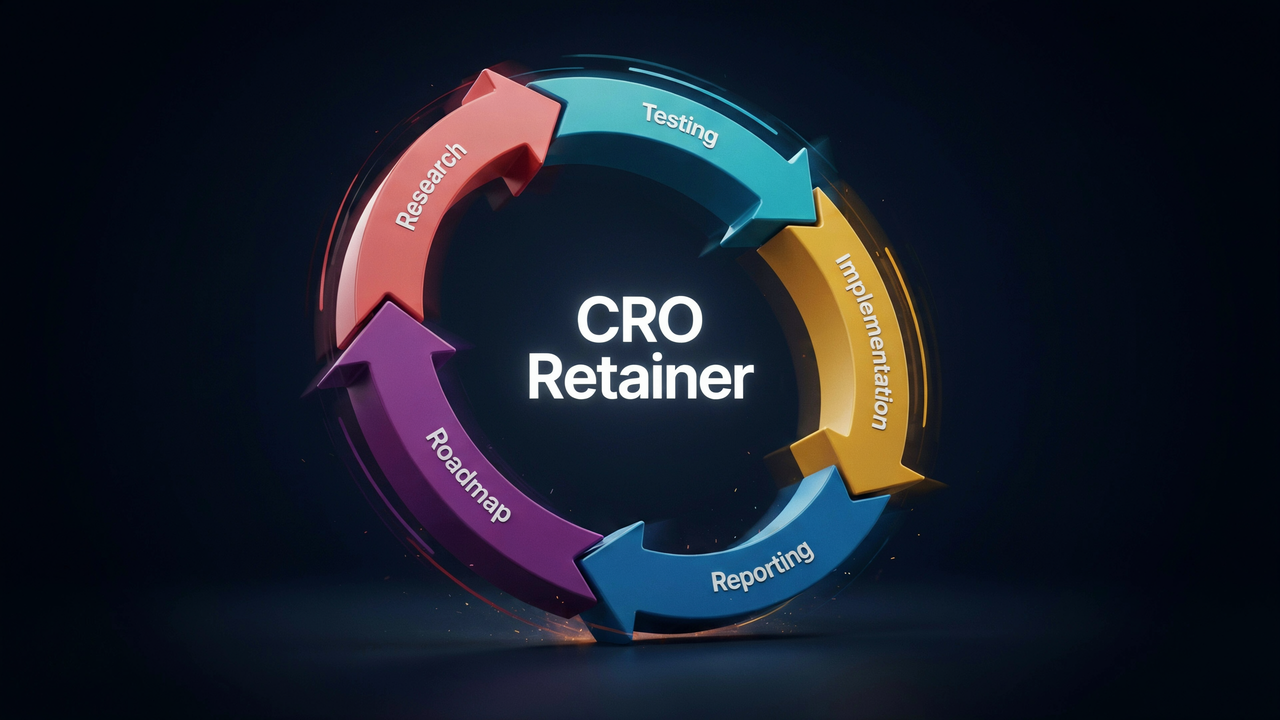
A CRO retainer should include ongoing research, structured A/B testing, end-to-end implementation, transparent reporting, and a clear growth roadmap. If yours doesn't have all five, you're probably paying for activity, not results.
TL;DR: A CRO retainer should include ongoing research, structured A/B testing, end-to-end implementation, transparent reporting, and a clear growth roadmap. If your retainer doesn't have all five, you're probably paying for activity, not results. This post breaks down exactly what to expect, what to avoid, and what ConversionFlow's retainer includes.
I'm going to tell you exactly what a good CRO retainer should include. And then I'm going to tell you the signs you're about to buy a bad one.
That's an unusual thing for an agency owner to write. I'm biased (I run a CRO agency, and I obviously want you to hire one). But I've also seen enough brands get burned by vague retainer agreements that I'd rather just lay it all out, even if it costs us a deal or two along the way. You'll make a better decision. That's the point.
Most retainers in this industry are sold on phrases like "ongoing optimization," "monthly recommendations," and "CRO strategy." None of those phrases mean anything on their own. Without a specific, documented deliverable structure behind each one, they're just words on a proposal. Good-sounding words. Empty words. And they're designed to look like a commitment without actually being one.
A retainer is only worth the money if it produces compounding, measurable results. Not deliverables for the sake of deliverables. Not reports for the sake of looking busy. Revenue lift, month over month, with a clear line drawn between the work and the outcome. That's the standard. Here's what meeting that standard actually looks like in practice.
What a CRO Retainer Should Include (The Non-Negotiables)
Research and Discovery (The Foundation)
Ongoing research isn't the glamorous part. It's also the part most agencies underinvest in after month one, once they've delivered the initial audit and are eager to start testing. That's a mistake.
A real retainer includes continuous qualitative and quantitative research: session recordings, heatmaps, funnel analytics, and user surveys. (Hotjar and Microsoft Clarity are the two most widely used tools for session recording and heatmap analysis.) It includes voice-of-customer work on a regular cadence: customer surveys, review mining, and support ticket analysis. It includes traffic analysis by source, device, and segment rather than just aggregate site numbers.
Without that ongoing research layer, a retainer becomes someone executing their assumptions month after month. The hypotheses get stale. The testing program drifts from what your customers actually need. And you end up paying for confident-sounding work that isn't grounded in anything real.
At ConversionFlow, the first 30 days of every retainer is heavily research-weighted. We won't test things we don't understand yet. Full stop.
Experimentation (The Engine)
Testing is the core output of a CRO retainer, but most programs don't do it rigorously enough.
A structured testing calendar should be tied to prioritized hypotheses, not random "let's try this" ideas. You should expect a minimum of 2 to 4 A/B tests per month depending on your traffic volume. Each test needs a documented hypothesis, a clearly defined success metric before launch, a minimum statistical significance threshold of 95%, and a post-test analysis that breaks results down by segment.
Tests should compound. Each one should inform the next. A testing program without a shared learning library is just noise. You're running experiments without building institutional knowledge.
That compounding effect is where the real value of a retainer comes from. Month four should be smarter than month one because of everything you learned in months two and three. A good testing program is cumulative. The best ones feel like a flywheel -- slow to start, unstoppable once they're running.
Implementation (The Part Many Agencies Skip)
This is where a lot of retainers quietly fall apart.
Recommendations without implementation are a consulting report, not a retainer. If the agency hands you a strategy doc and waits for your dev team to build it, every handoff is a delay. Every handoff is a misinterpretation. Every handoff is a week of momentum you don't get back.
ConversionFlow handles end-to-end: strategy, design, development, and QA. The reason this matters isn't just efficiency. It's fidelity. The test that actually runs in production should be the test that was designed. Not a version of it. Not a close approximation. When everything goes through the same team, nothing gets lost in the handoff.
Implementation is where momentum lives or dies.
Reporting and Communication (Transparency, Not Theater)
Monthly reporting should tell you one thing clearly: is this retainer making you money?
That means test results with statistical confidence levels, revenue impact modeling, and a clear view of next month's priorities. It does not mean a dashboard full of sessions, impressions, and bounce rates dressed up as progress. Those are not CRO KPIs.
Reporting should tie directly to your P&L. Revenue per visitor. Conversion rate by segment. Average order value. Profit impact. If the monthly report doesn't connect to those numbers, it's theater.
ConversionFlow's standard: no surprises. If a test underperformed, you hear about it before the monthly call, not during it. And you hear about what we're doing next, not just what happened. Clients should never feel like they're reading a report about a stranger's website.
A Clear Growth Roadmap (The Strategic Layer)
Individual tests are tactics. A retainer without a roadmap is just a series of tactics with a monthly invoice attached.
Our growth roadmaps usually span 12 to 18 months, but a good retainer should have a bare minimum 90-day roadmap of priorities aligned to your actual revenue goals, with quarterly strategy sessions to reassess and adjust as the data evolves. The roadmap is what keeps the program from becoming purely reactive. It's the difference between running tests and building a growth engine.
Without it, you're optimizing in circles. With it, you're building something that gets more valuable with every month that passes.
What a CRO Retainer Should NOT Include (Red Flags)
Here's the honest part. The things to watch for before you sign anything.
1. Deliverables without revenue context. "We delivered 4 tests this month" is not a result. Did those tests produce revenue lift? That's the only question that matters.
2. A/B testing on low-traffic pages. Running tests on pages with under 500 sessions per month produces statistically unreliable results that shouldn't guide decisions. If an agency proposes testing on low-traffic pages without explaining how they'll handle the statistical challenges, ask why.
3. Strategy-only retainers. A document full of recommendations with no implementation support is a philosophy, not a service. Strategy without execution doesn't move revenue.
4. Month 1 "audits" that produce a slideshow and nothing else. A real audit generates an action plan with a testing calendar and quick-win implementations. A 40-slide deck you'll look at twice is not an audit. It's busywork in presentation format.
5. No defined success metrics upfront. If the agency can't tell you exactly how you'll know the retainer is working after 90 days, that's a problem. "We'll optimize things" is not a success metric. Revenue per visitor up 15% in 90 days is a success metric.
6. Vanity metric reporting. Bounce rate, impressions, and session counts are not CRO KPIs. If those are the lead metrics in your monthly report, someone is obscuring the truth about performance.
Any one of these should give you pause. More than one is a reason to walk away.
CRO Retainer vs. Project-Based CRO (Which Is Right for You?)
CRO compounds over time. That's the core case for a retainer. A six-month retainer produces more value than six individual projects because the learnings from month two inform month four, and month four informs month six. The program gets smarter with every cycle.
That said, not every brand is ready for a retainer. If you're under 10,000 monthly sessions, a project-based engagement may make more sense. You need directional wins and foundational improvements before you have enough traffic to test rigorously. Rigorous A/B testing on thin traffic produces noise, not learning.
ConversionFlow offers a Conversion Design Program specifically for lower-traffic brands (under 30,000 sessions per month). It's design-led improvement grounded in qualitative research rather than statistical testing. The right tool for the right stage of growth.
The honest answer: the best engagement model depends on your traffic volume, your revenue goals, and your internal capacity to move fast when an opportunity is identified. A good CRO partner will tell you which model fits your situation, even if that means recommending a smaller engagement. If the first thing out of their mouth is the most expensive option, pay attention to that.
What to Expect in the First 90 Days of a CRO Retainer
Here's how the first 90 days of a ConversionFlow retainer actually runs:
Days 1 to 30: Research-heavy. Analytics setup and audit. Session recording review across high-traffic pages and key conversion paths. Voice-of-customer research including surveys and review mining. Identification of the highest-priority friction points. First quick-win implementations for things that are so clearly broken they don't need a formal test. Just a fix.
Days 31 to 60: First structured A/B tests launch based on research-backed hypotheses. Brand differentiation analysis to understand what your store communicates versus what it should communicate. Deeper funnel analytics to surface hidden drop-off patterns.
Days 61 to 90: Full testing cadence is underway. A detailed customer portrait is built from both qualitative and quantitative data. The roadmap for the next 90 days is established based on everything learned so far. The first revenue-impact report is delivered with clear before-and-after numbers and a projection of where the program is headed.
Most clients see measurable lift within 30 to 45 days, primarily from quick-win implementations in the research phase. The compounding results build from there as the testing program matures, the learning library deepens, and the hypotheses get sharper with each cycle.
ConversionFlow guarantees a minimum 10% lift in conversion rate for qualifying brands within 60 days. That's not a marketing line. It's a commitment we put in writing.
Final Thought: A Retainer Should Pay for Itself
A CRO retainer that doesn't produce a clear, measurable return within 90 days is not a CRO retainer. It's an expense.
The right partner will be able to show you, in numbers, exactly why the engagement is worth the investment. Every month. Not in sessions or slide decks. In revenue.
ConversionFlow's average ROI across clients is 18.3x. That's the benchmark we hold ourselves to, and it's the benchmark you should hold any CRO partner to. Ask them for it directly. Ask to see how they measure return. Ask what happens if they don't deliver. How they answer those questions will tell you everything.
You deserve a retainer that earns its place on your P&L. Every single month. Anything less than that isn't optimization -- it's overhead.
Want to see exactly what a ConversionFlow retainer looks like in practice? Book a free strategy session.
Frequently Asked Questions
Common questions about what a CRO retainer includes, how much it costs, how quickly results appear, and how to evaluate whether yours is actually working.
About Author
.avif)