How to Lower Customer Acquisition Costs (CAC) Without Spending More on Ads
Rising CAC is a conversion problem, not a media buying problem. If your store converted better, every dollar you already spend on acquisition would generate more customers. This post covers seven conversion-side levers that reduce effective CAC without touching your ad budget.
TL;DR: Rising CAC is a conversion problem, not a media buying problem. If your store converted better, every dollar you already spend on acquisition would generate more customers. This post covers seven conversion-side levers that reduce effective CAC without touching your ad budget -- plus the math that shows exactly why they work.
Most brands facing rising customer acquisition costs respond the same way: spend more. Test a new channel. Hire a new media buyer. That's the wrong answer.
iOS privacy changes gutted targeting precision. Platform saturation has driven CPMs to levels that would have seemed absurd five years ago. And paid acquisition has become genuinely less predictable -- not because of bad strategy, but because the environment shifted. More spend doesn't fix any of that.
The brands that keep responding with budget increases aren't addressing the underlying problem. They're just paying more to expose a broken funnel to more people.
Here's the actual problem: your store isn't converting efficiently enough to justify the cost of sending traffic to it. The fix isn't more spend. It's a better-converting store.
Every strategy in this post reduces CAC not by cutting ad spend, but by making your existing spend work harder. That's the only sustainable path forward.
Understanding CAC (And What Actually Drives It Down)
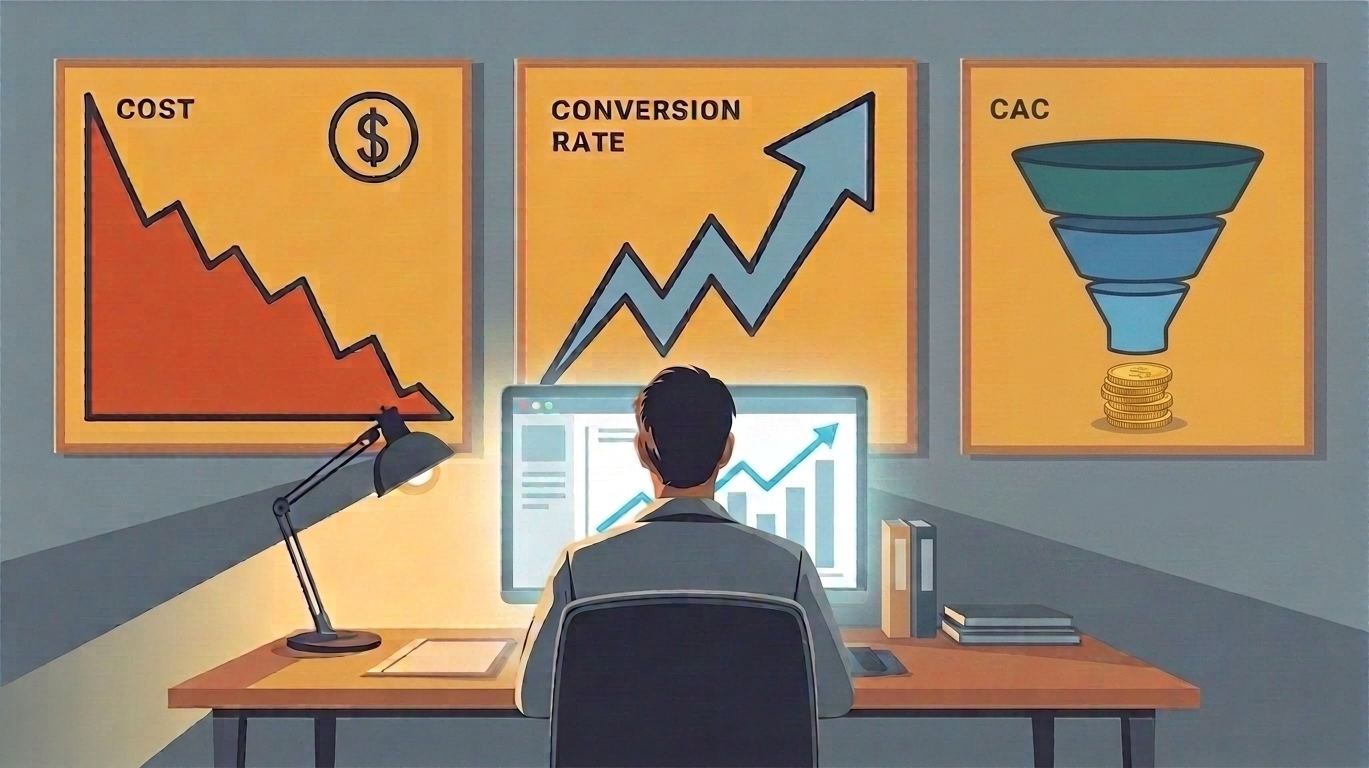
Customer acquisition cost is simple math: total acquisition spend divided by the number of new customers acquired in a given period.
If you spent $20,000 in a month and acquired 400 new customers, your CAC is $50.
The lever most brands ignore entirely is conversion rate. If you double your conversion rate with the same ad spend, you acquire twice the customers -- which cuts your effective CAC in half. Zero change to your media budget. Zero new channels to manage.
AOV plays a role too. A higher average order value means each customer is worth more on the first transaction, which gives you more room to absorb a higher CAC and still be profitable. And repeat purchase rate affects the sustainable ceiling for your CAC: if customers come back and buy again, the acquisition cost gets distributed across more revenue, making it look dramatically cheaper in hindsight.
This post focuses on the conversion side of the equation. Not media buying. Not audience targeting. The question is: given the traffic you're already paying for, how do you extract more customers from it?
1. Fix Your Landing Page-to-Ad Alignment (The Fastest CAC Win)
Most wasted ad spend isn't wasted in the ad itself. It's wasted at the landing page.
When your ad creative promises one thing and your landing page delivers something different, bounce rates spike. Visitors feel disoriented. They leave. You pay for that click anyway.
Message mismatch is the specific culprit. If your ad headline says "25% off your first order" and your landing page leads with a brand story, you've already lost the visitor you just paid to acquire. The fix is straightforward: the headline on your landing page should mirror the offer in your ad. The promotion your ad promotes should be immediately visible. The tone and segment language should match what the ad set was targeting.
In our experience at ConversionFlow, message mismatch between ad and landing page is one of the top three conversion problems we find during initial audits. It's also one of the fastest fixes.
Cute.Camera is a good example. After landing page and product detail page optimization (which included tightening ad-to-page alignment), founder Ian Lindstrom saw CAC drop by 50% and was able to reduce total ad spend by 50% simultaneously. The store was simply converting better on the traffic it already had.
Fix the alignment before you scale the spend. Scaling a misaligned funnel makes the problem more expensive, not smaller.
2. Improve Conversion Rate on High-Traffic Pages (Math That Compounds)
The math here is worth spelling out because it's more powerful than most brands realize.
You're spending $10,000 per month to drive 10,000 visitors. Your store converts at 2%. That's 200 customers acquired at a CAC of $50 each.
Lift your conversion rate to 3% -- same spend, same traffic -- and you get 300 customers. Your CAC drops to $33. That's a 34% reduction in acquisition cost with no additional media investment.
The math is straightforward. The execution is where most brands stall.
On high-traffic pages -- primarily your product detail pages, collection pages, and homepage -- the highest-leverage improvements tend to be: clarifying your PDP hierarchy (lead with what matters most to a buyer in decision mode), reducing friction in checkout, adding trust signals at the exact moments buyers hesitate, and fixing the mobile experience, which is frequently where conversion falls apart.
Across our client base, ConversionFlow has delivered an average CVR lift of 10.2%. Run that number through the math above for a typical client spending $20,000 per month and the CAC reduction is material -- often more than $15 per customer acquired.
Better conversion rates don't just lower CAC. They give you a business that actually scales.
3. Increase Average Order Value (Give Each Customer More Room to Cost)
Higher AOV means each customer is worth more on the first transaction. That gives you more room to sustainably absorb a higher CAC without going unprofitable.
Think of it this way: if your CAC is $40 and your AOV is $60, you have a tight margin to work with. If your AOV climbs to $90, the same $40 CAC looks very different on a P&L.
The tactics here are practical and well-tested: product bundling that creates perceived value (not just artificial groupings), order bumps at checkout that are genuinely relevant to what the customer is already buying, post-purchase upsell flows before the thank-you page, and tiered free shipping thresholds that nudge customers toward adding one more item.
ConversionFlow clients see an average AOV increase of 21.2% through these kinds of optimizations. For a brand with a $70 AOV, that's roughly $15 more per order -- which directly changes the ceiling on what you can sustainably pay to acquire a customer.
AOV optimization and CAC reduction aren't separate initiatives. They're the same problem viewed from different angles.
Raise what a customer is worth. Your CAC math improves automatically.
4. Reduce Bounce Rate on Paid Traffic (Stop Paying for Visitors Who Leave)
Every visitor who bounces is a paid acquisition that returned zero revenue. You paid for the click. You got nothing.
Bounce rate on paid traffic tends to have a few consistent culprits: slow page load time (every second of delay has a measurable conversion cost), poor mobile experience (most paid traffic lands on mobile), a homepage value proposition that doesn't communicate quickly or clearly, and the ad-to-page message mismatch covered above.
For dedicated paid traffic landing pages, the principle is different from your organic site experience. Strip out distractions. Remove or minimize navigation. Give visitors one clear action above the fold. The goal isn't to let people explore -- it's to convert the intent your ad already created.
Bounce rate reduction and conversion rate improvement often come from the same set of fixes. If a page is confusing or slow, visitors leave before converting. Solve one, you've usually made progress on both.
Every visitor who bounces is money you've already spent with nothing to show for it.
5. Improve Retention and Repeat Purchase Rate (Lower CAC by Spreading It Across More Orders)
CAC is technically a first-purchase metric. But that's somewhat misleading, because the real question is what that customer costs you relative to the total revenue they generate.
If a customer buys once and never returns, your CAC absorbs the full cost of acquiring them. If that same customer buys again -- and again -- your effective CAC per revenue dollar drops every time.
A 2x repeat purchase rate, all else equal, roughly halves your CAC in terms of revenue generated per acquired customer. That's a significant improvement without touching a single ad.
The tactics are largely operational: a well-constructed post-purchase email sequence that encourages the second sale, a loyalty or rewards program that creates meaningful reasons to return, subscription options for any product that gets consumed and reordered, and personalized product recommendations that surface relevant items based on purchase history.
And here's the CRO angle that often gets missed: the post-purchase experience is a conversion funnel for the second sale. Treat it like one. Optimize it with the same rigor you apply to your PDPs.
Lower CAC by making customers worth more, not just by paying less to acquire them.
6. Optimize for High-Intent Traffic (Spend Where It Converts)
Not all traffic converts at the same rate, and not all channels deserve equal budget allocation. Cold social traffic from someone who's never heard of your brand converts very differently from branded search traffic from someone who already knows they want what you sell.
Audit your traffic sources by conversion rate, not just volume. This is a report most brands can pull in Google Analytics 4 in ten minutes, and it tends to be revelatory.
What you typically find: branded search converts at a significantly higher rate than unbranded search, which converts higher than paid social, which varies wildly by creative and audience. If you shift budget toward channels and segments that convert efficiently, your blended CAC improves even if your total spend stays flat.
Find your highest-converting traffic sources and ask why they convert. What's different about the visitor's intent when they arrive through that channel? What expectations do they carry? Then work backward to replicate those conditions for other traffic where you can.
Traffic that doesn't convert isn't cheap. It's expensive. Spend where the math works.
7. Use CRO to Justify Higher Bids (The Offensive Play)
Everything above is defensive -- improving conversion to reduce the cost of what you're already spending. This section is the offensive move.
If your store converts at 3% and a competitor converts at 1.5%, you can afford to bid twice as much for the same traffic and still generate the same number of customers at the same cost. In auction-based platforms like Google and Meta, that's a structural advantage. Google's own Smart Bidding documentation confirms that landing page experience and conversion quality directly influence auction competitiveness.
The brand that converts best can outbid everyone else while maintaining profitability. That's not a coincidence or a lucky outcome. It's a direct result of investing in the conversion side of the funnel.
Better conversion rates don't just lower CAC passively. They let you be more aggressive in paid channels than competitors who haven't made that investment. They turn CRO from a cost-reduction play into a market share play.
The brand that converts best can spend the most. That's the endgame.
Final Thought: CAC Is a Conversion Problem in Disguise
Rising CAC is a symptom. The root cause, in the vast majority of cases, is a store that isn't converting well enough to justify the spend it takes to fill it with traffic.
The instinct to solve a CAC problem by adding more budget is understandable. It's also backwards. Fix the conversion rate first. Then scale the spend. In that order.
The brands winning on paid acquisition right now aren't outspending the competition. They're out-converting it. And that gap compounds over time, because every improvement to conversion rate makes the next dollar of ad spend more profitable than it was before.
Want to find out how much CAC reduction is hiding in your current store? Book a free strategy session with ConversionFlow.
Frequently Asked Questions
Common questions about customer acquisition cost, what drives it, and how conversion optimization reduces it without increasing ad spend.
About Author
.avif)